
Know the Product · Part Forensics
The customer reads “6ES5 451-4UA1” off a dead module. The missing digit is the easy part.
Bottom line: A worn order number on an old PLC module is only the start of product discovery. To quote a replacement that works, an expert has to find the missing digit, the module’s version, its address and jumper settings, the right front connector and the reason it failed, then choose between surplus stock, repair, a successor and migration.
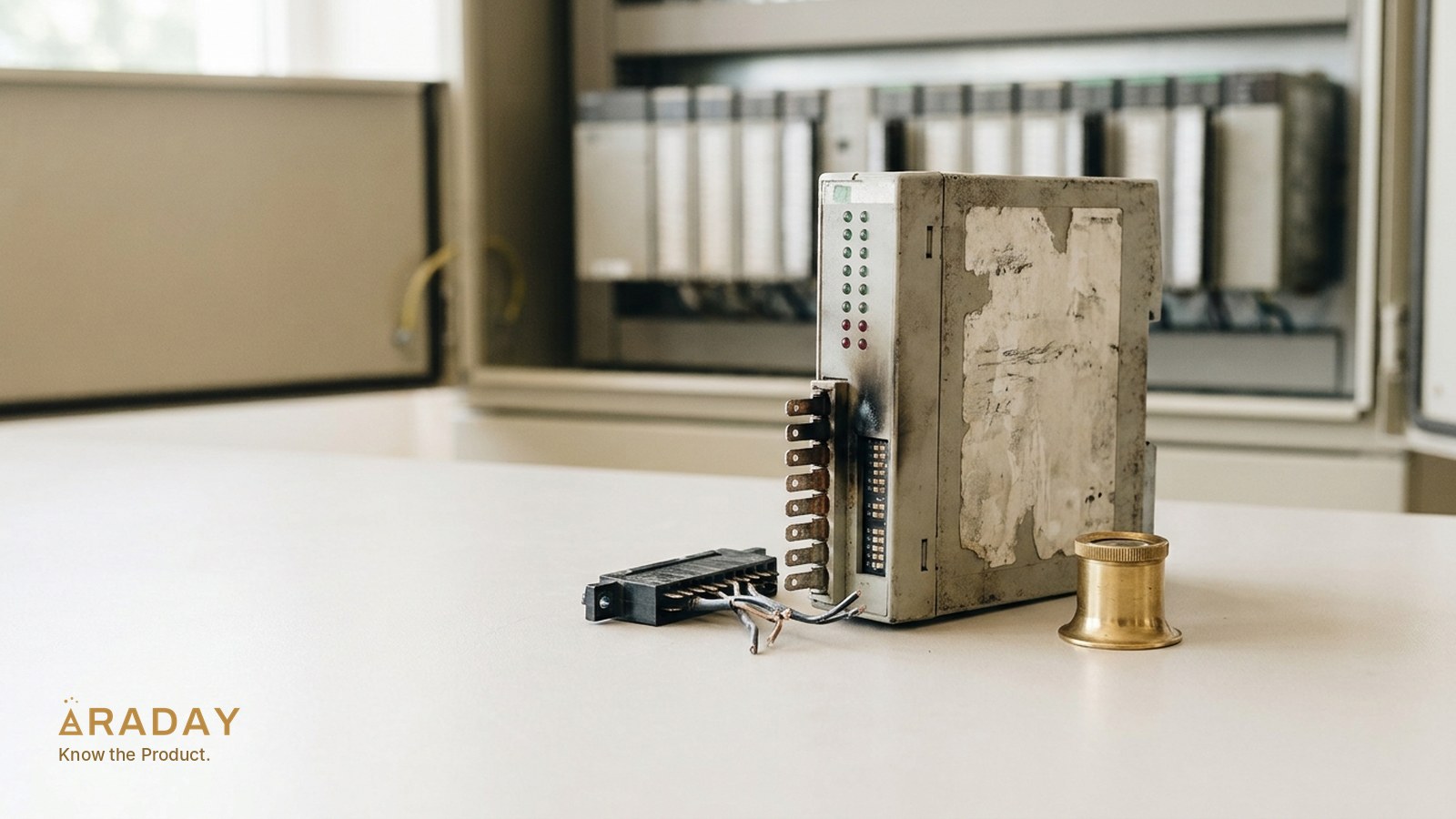
A line is down. The controller running it was installed decades ago. Maintenance has pulled a dead output module out of the rack, and the label is half gone. They read you what’s left: “6ES5 451-4UA1.”
The call gets walked over to Bob.
What Bob does next has a name: product discovery, turning what the customer has into the exact part that will work. On most calls it’s a few questions. On this one, it’s the whole job.
Bob knows the missing digit is the least of it. Before anything gets quoted, he needs answers to half a dozen questions the customer hasn’t thought of yet.
What “6ES5 451-4UA1” tells you
“6ES5” puts it in the Siemens SIMATIC S5 family. “451” makes it a digital output module.
That’s less than it sounds like. Siemens built a 451 output module for more than one S5 system. Its S5-to-S7 migration guide lists one for the S5-115U (6ES5 451-7LA11) and another for the S5-135U and S5-155U (6ES5 451-4UA14). Same number, different racks.
So the first question isn’t about the module at all. It’s about the system around it: which rack, which CPU?
Four modules, one missing digit
If the rack is an S5-135U or 155U, the missing digit narrows the module to one of four. Siemens’ product pages describe all four as 32-output, 24V DC, 0.5A digital output modules:
| Order number | Siemens’ status | Siemens’ listed successor |
|---|---|---|
| 6ES5 451-4UA11 | End of product life cycle | 6ES5 451-4UA14 |
| 6ES5 451-4UA12 | End of product life cycle; spare part only | 6ES5 451-4UA14 |
| 6ES5 451-4UA13 | End of product life cycle | 6ES5 451-4UA14 |
| 6ES5 451-4UA14 | End of product life cycle; spare part | None listed |
It’s tempting to stop there and quote the -4UA14. Siemens names it as the successor to the other three.
But successor doesn’t always mean identical. Siemens’ own S5-135U/155U System Manual lists the -4UA13 and -4UA14 side by side, and they differ:
| 6ES5 451-4UA13 | 6ES5 451-4UA14 | |
|---|---|---|
| Output fusing | 6.3 A slow, 1 per 8 outputs | 7 A fast, 1 per 8 outputs |
| Breaking voltage (inductive loads) | Limited to L+ − 47 V | Limited to L+ − 55 V |
| Current draw from L+ | 150 mA typical | 200 mA typical |
| Power dissipation | 17.0 W | 6.4 W |
Similar job, different module. Whether the difference matters depends on the machine. Finding that out is the expert’s job.
Why did it fail?
This is the question the customer rarely asks, and the one an expert asks early.
A dead output module is often a symptom. Siemens’ manual explains why. The fuses on its DC output modules “can only be replaced at the factory,” so a short in the field wiring can put the module out of service for good. And the built-in circuits that protect the module from inductive loads, such as contactors, solenoid valves and relays, are disabled whenever the load circuit is opened. Without external suppression (a diode, an R/C network or a varistor), the manual warns, the resulting voltages put fault-free operation at risk.
Put a new module into the same fault, and you’ll be taking the same call next month.
The call, question by question
Here’s how the product expert works through it, and why each answer matters:
| The expert asks | Why it matters |
|---|---|
| Read me every label on it, not just the front. | The full order number, and the version. Siemens’ modules carry a separate field for the version, and the manual says to update it when a module is replaced. |
| Which rack and CPU, and what else is in the rack? | Which “451” it is, and which successors and connectors apply. The other modules matter too: Siemens’ manual warns against setting an address that’s already in use. |
| What happened right before it failed, and what’s wired to it? | A shorted line or an unsuppressed coil will kill the replacement too. |
| How is the addressing switch set? | Each module has one. It sets the address the program uses, so the replacement has to match the original. |
| Is the enable jumper in or out? | The 451 has an enable jumper, X20, factory-set to active. The replacement should be set the same way. |
| Is the front connector intact, and is there a fan in the rack? | The connector is a separate part. Siemens lists the narrow 20 mm crimp connector for the 451 only in fan-cooled racks; without a fan, it’s a 40 mm crimp or a screw connector. The front connectors listed for it on Siemens’ site are at end of life too (crimp, screw). |
| How many, and how fast? | A line down today and a planned spare are different quotes. |
None of those answers is printed on the part in the customer’s hand.
Why this call decides the order
Product discovery comes before price, stock and delivery. Until it’s done, nobody can quote.
On a call like this, the stakes are higher than usual. The line is down, and the customer is likely calling more than one distributor. The one who asks the right questions first, and quotes a module that will actually work in that rack, gets the order. Quote the wrong module, or the right module into the same fault, and the customer is back on the phone with a second failure, a return and a line that’s still down.
That’s why this call goes to Bob. Knowing the missing digit is easy to look up. Knowing the six-plus questions after it is what the customer is really paying for.
When the part is out of production
Siemens’ migration guide says S5 components have been discontinued since 2003. Spare parts are still largely available, but only in exchange for the old component, and the number available keeps shrinking.
So the expert lays out the options, roughly in this order:
- Surplus or used stock of the exact number. The fastest way to get the line running, if the exact module can be found.
- Repair of the failed module. Often cheaper, but slower.
- Siemens’ successor, if one is still available and checks out against the differences above.
- Migration. The long-term answer, and the biggest job. Even the modern module Siemens’ guide maps the 451 to, the S7-1500 6ES7 522-1BL00-0AB0, has itself been superseded, by the 6ES7 522-1BL01-0AB0, a high-feature version of the original standard module.
A customer who has kept an S5 system running this long has usually decided to keep it running a while longer. The expert’s job is to keep it running without creating the next failure.
It’s not an AI problem, it’s a data problem
Everything this call needed exists in writing somewhere: Siemens’ product pages, a system manual from 1999, a migration guide, the labels on the module, and the history of the machine it came out of. None of it is in one place, and none of it is attached to the part on the counter.
That’s the industrial product data problem in a single phone call. It’s why calls like this one end up with the one person who knows.
Experts like Bob are scarce, and product discovery is where their time goes. The more of the routine calls that come off their desk, the more of that time goes where only they can help: the hard calls, like this one.
Key terms
- Order number: Siemens’ orderable number for a module, such as 6ES5 451-4UA14.
- Product version: A separate marking on the module that records its version; Siemens says to update it when replacing a module.
- Successor: The product Siemens names as the replacement for a discontinued one. Not always identical.
- Addressing switch: The switch on an S5 module that sets the address the program uses.
- Front connector: The separately ordered connector that carries the field wiring to the module.
Sources
- SIMATIC S5-135U/155U System Manual (Edition 11/99). Siemens.
- Product pages for 6ES5451-4UA11, -4UA12, -4UA13, -4UA14, 6ES5497-4UA12, 6ES5497-4UB12, 6ES7522-1BL00-0AB0 and 6ES7522-1BL01-0AB0. Siemens.
- Guide for Migrating SIMATIC S5 Projects to SIMATIC S7. Siemens.
Leave a Reply