
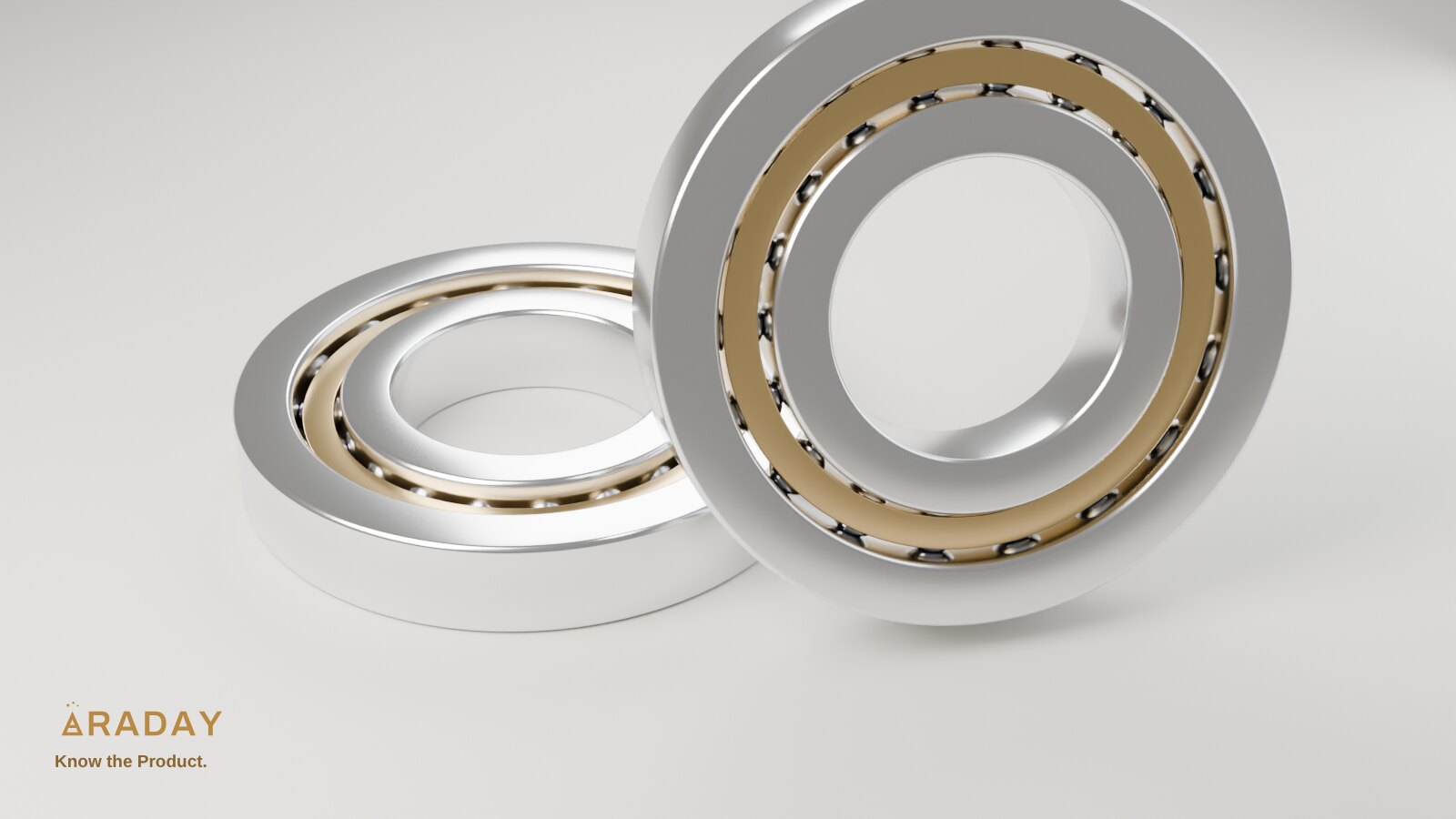
Know the Product · Part Forensics
A customer reads you “B7026.” The box is long gone. To order the right spindle bearing, you need six more answers; the customer doesn’t have them.
Bottom line: “B7026” tells you it’s an angular contact bearing, with some basic data like size. It doesn’t tell you the contact angle, sealing, cage, tolerance class, arrangement or preload, and those are what make it orderable. Finding them is a product discovery job: the right questions, asked in the right order, to the person holding the part.
The call is a familiar one. A machine tool spindle is down, holding up the rest of production, and the customer has one thing to give you: B7026.
The manufacturer’s box with full specs went in the trash years ago, label and all. What’s left is an incomplete number: either the full MPN was never marked, or it wore off.
Failed parts usually don’t have the full or accurate MPN. Product discovery must be conducted to identify the part and get to the full, orderable MPN.
Sometimes you get lucky and the rest turns up in minutes. Sometimes the best people in the building can’t pin it down. Here’s what that number holds, what it leaves out, and how an expert closes the distance.
What “B7026” tells you
B70 is the series: a Schaeffler FAG super precision spindle bearing, an angular contact ball bearing built for machine tool spindles. Change the prefix and you change the bearing; HC, for example, marks a hybrid with ceramic balls.
26 is the bore code. Multiply by five: a 130 mm bore.
That fixes the envelope at 130 × 200 × 33 mm. It doesn’t fix the bearing.
This is the easy part, and any bearing and power transmission (BPT) expert can tell you this in seconds. But the issue is it only tells a small portion of what the part truly is.
Three bearings, similar nomenclature
Schaeffler’s product data lists several B7026 bearings. Here are three, all 130 × 200 × 33 mm:
| B7026-C-T-P4S-UL | B7026-E-T-P4S-UL | B7026-E-2RSD-T-P4S-UL | |
|---|---|---|---|
| Contact angle | 15° | 25° | 25° |
| Sealing | Open | Open | Sealed, greased for life |
| Dynamic load rating | 149,000 N | 141,000 N | 141,000 N |
| Speed limit, grease | 6,700 rpm | 6,000 rpm | 6,000 rpm |
| Max. operating temp. | 100 °C | 100 °C | 80 °C |
| Axial rigidity, light preload | 137 N/µm | 326 N/µm | 326 N/µm |
All starting with B7026, every one fits the same shaft and housing. None is a substitute for the others. The three are different parts with similar numbers, and they’re easy to mix up, especially when the customer is in a rush.
How an expert finds the rest
Markings don’t always survive. Some makers mark the full number on the ring; many mark less. In service, markings get worn, ground down, burned off or buried in grease and grit, and a bearing that overheats in failure can lose its number entirely. The same happens across the majority of industrial parts.
So an expert works from two sides: the part itself, and the people and records around it. The first call often sounds like this:
Tech: “All I can read on the ring is FAG B7026.”
Expert: “Is it open or sealed, how many came off that end of the spindle, and what’s the application?”
From the part
- Measure it. Bore, outside diameter and width, on a clean, undamaged ring. For B7026 that’s 130 × 200 × 33 mm. Size points to a series, but as the table shows, several bearings share one envelope.
- Look at it. Open or sealed on both sides settles 2RSD. The cage’s material and color narrow the cage code.
- Check its neighbors. Spindle bearings run in pairs or sets. A surviving partner may still be readable, and the order they came off tells you the arrangement.
From the people and records
- “Read me everything on both ring faces, look closely.” Extra characters sometimes survive under the grease.
- “Grease or oil lubrication?” A second check on sealed versus open.
- “What’s the machine, the spindle maker and the model?” The builder’s parts list or service desk can sometimes supply the full number, though that’s rare.
- Check your own sales history. If the customer bought this bearing from you before, the full number may be in your system.
- “Is there a work order, a rebuild report or an old purchase order?” The plant’s records are often the fastest route.
- Application. Check the specs from the machine OEM if available.
How the hard two get settled
Size, sealing and cage usually come off the part or a good description and photos. The two that decide the order, contact angle and preload, almost never do. Here’s how a rep settles them from the counter and the computer, without the bearing ever leaving the plant.
- Contact angle: the partner bearing. In this case the tech went back to the spindle. The bearing from the other side of the set was still readable, and it carried an E. That’s 25°, and it confirms the bearings ran as a set.
- Preload: the paper trail. Preload is ground into the rings as a step measured in microns. A rebuild shop can check it on the bench; a rep can’t from a phone call. So the rep goes to the records: the partner bearing’s full number if it survived, the customer’s purchase history, the plant’s last rebuild report, or the spindle builder’s parts list.
- When the trail runs out, the rep says so and works it with whoever rebuilt the spindle, rather than guessing. A wrong preload still fits.
Asking the right questions, in the right order, is how an expert uncovers what the part truly is and gets to the exact, orderable MPN. The distributors who do it accurately with speed win the order.
What the full number says
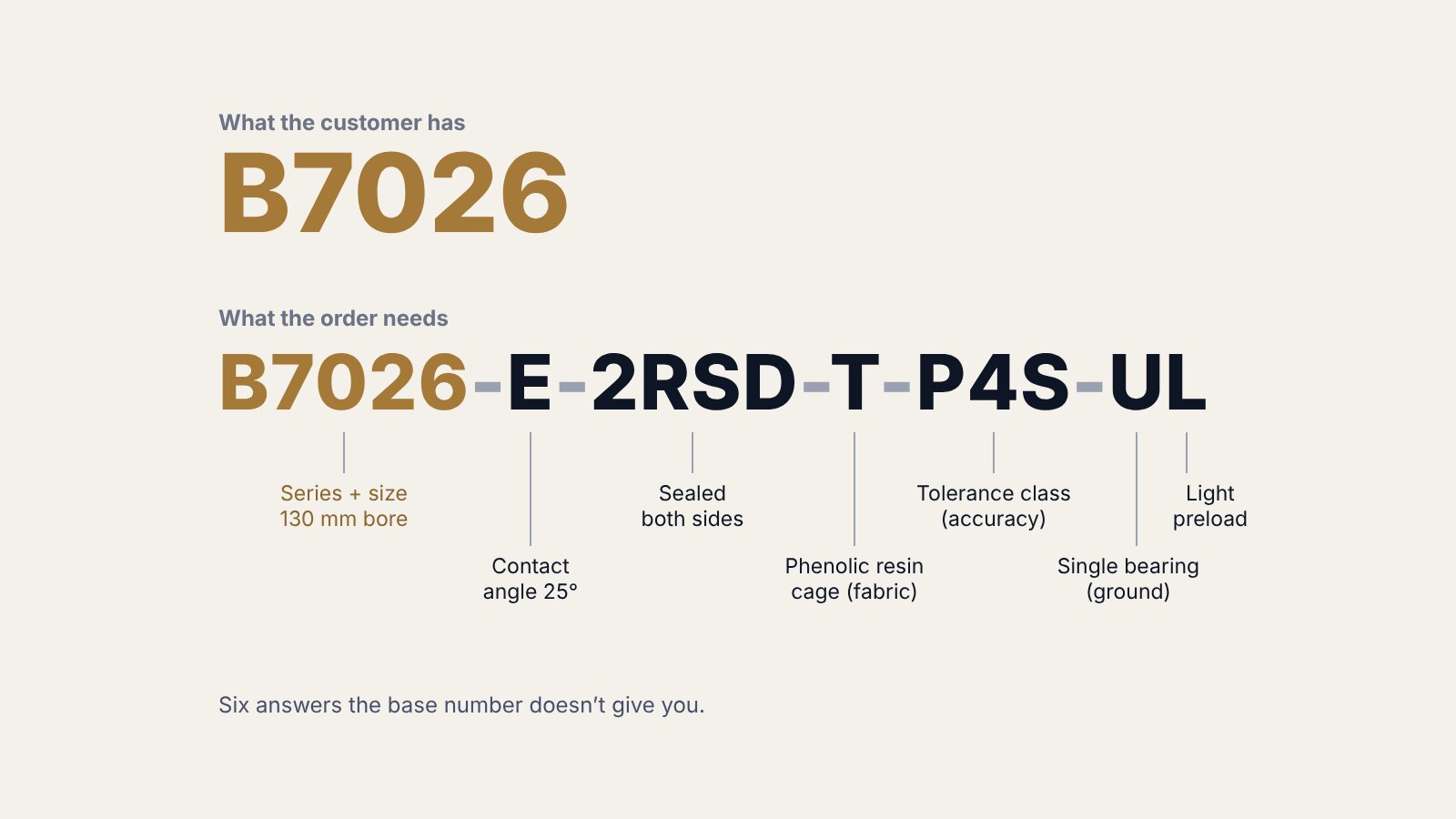
Put the answers together and the full number comes back: B7026-E-2RSD-T-P4S-UL, the sealed bearing from the table. Here’s what each segment says.
E is the contact angle, 25°. It sets how the bearing splits radial and axial load, which is why the table moves on rigidity and speed.
2RSD means non-contact seals on both sides, greased “for life.” Without it, the bearing is open and lubricated by the spindle’s own system.
T is the cage: phenolic resin, a laminated fabric.
P4S is the tolerance class (accuracy), which Schaeffler describes as its FAG standard, better than P4 to ISO 492:2023.
UL is two answers. U means a single bearing, ground (flush) so it can be adjusted into pairs or sets. L is light preload.
Preload is the segment you can’t guess
The base number doesn’t show preload. On the same B7026-E bearing, Schaeffler lists a preload force of 1,312 N at light, 4,328 N at medium and 8,915 N at heavy, while axial rigidity climbs from 326 to 689 N/µm. Nearly seven times the preload, in a bearing that looks identical.
Schaeffler is plain about it: the ordering designation must always include the arrangement and the preload. The base number carries neither.
Can it be measured? Bearing makers publish ways to check preload once a set is mounted in the spindle, read against the maker’s curve for that arrangement. That’s shop work, not counter work. The ground preload step itself is recorded on the box label. The box that went out with the trash.
It’s not an AI problem; it’s a data problem
Every one of those answers existed the day the spindle was built. They sit in a maker’s catalog, a builder’s parts list and a plant’s maintenance records, and none of them traveled with the part.
Pulling them back together depends on someone who knows which questions to ask, and in what order. When that person retires, the questions leave with them. That is the industrial product data problem in a single phone call.
Key terms
- Bore code: Digits after the series that encode the bore; for these bearings, code × 5 = bore in mm.
- Contact angle: The angle at which load passes through the balls; it sets the balance between radial and axial capacity.
- Preload: An internal axial load set into a bearing or set to remove play and add rigidity.
- Product discovery: Working from partial information to the exact, orderable part.
Sources
- B7026-C-T-P4S-UL, B7026-E-T-P4S-UL and B7026-E-2RSD-T-P4S-UL product data. Schaeffler.
- Super Precision Bearings (SP 1). Schaeffler.
- X-life High-Speed Spindle Bearings. Schaeffler.
- Machine Tool Spindle Bearing Selection & Mounting Guide. NSK.
- How to read bearing numbers and what to do when the marking is no longer visible. Bearing Express.
Leave a Reply