
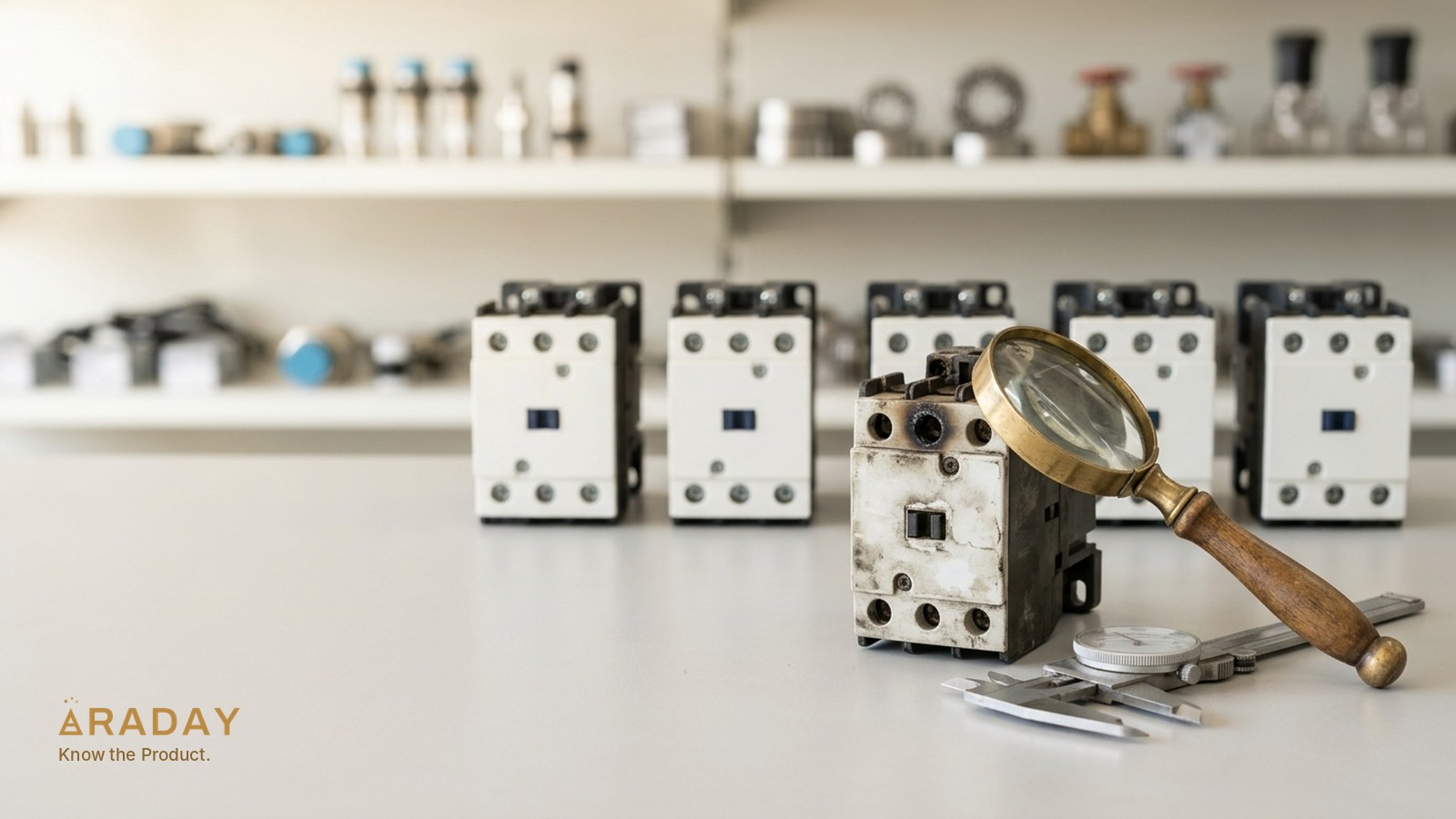
Know the Product
Most industrial orders start without a part number, and at most distributor branches one person works out what the customer actually needs.
Bottom line: Most industrial orders arrive without the full or orderable part number. Product discovery is the work of finding it, and the distributors who do it accurately and fast answer first and win the order.
A maintenance tech calls in. A line is down. She has the failed part in her hand, or a photo of it, or a few characters off a worn label. What she doesn’t have is the number the manufacturer will ship against: the MPN.
Before anyone can quote a price, check stock or promise delivery, someone has to work out exactly what that part is. That work is product discovery. At most distributors, one person does it: the one every hard call gets walked over to.
You’ll also hear it called part identification, product identification, resolving the part or a part lookup. The work is the same.
What is product discovery?
In industrial distribution, product discovery is the work of turning what a customer has or needs into the exact, orderable manufacturer part number (MPN).
What comes in is rarely clean:
- A description: “a bearing for the lathe headstock,” “a 24V contactor for this panel”
- A base number with the rest missing
- A worn, painted-over or partial marking
- A competitor’s or machine builder’s number
- A photo, some attributes, or an old work order
And sometimes the failed part was the wrong part to begin with, because product discovery wasn’t done right the last time. You’re forced to start over.
What has to go out is one exact, correct part. Every character counts, because one wrong character can mean a part that doesn’t fit, doesn’t run or doesn’t last. Nomenclature is important.
In e-commerce, “product discovery” also means helping shoppers browse a web store, mostly in retail. That’s a different job. At the industrial counter, it means identifying the part, and it comes before everything else on the order; it’s the first and most important step.
Why most industrial orders start without a part number
If parts carried their full number and every customer read it off fully, this job wouldn’t exist. They don’t, for many reasons.
Markings don’t survive. Parts run hot, get washed down, painted and greased, labels and stickers get torn, stampings get ground down. Some argue this is all by design. A bearing that overheats in failure can lose its number entirely.
The base number isn’t the whole number. Many parts carry a designation that names the family and size, while the details that make it orderable sit in a suffix that isn’t marked, isn’t legible, or is gone. The spindle bearing in the Part Forensics series is a good example: four characters on the ring, and the rest has to be found.
OEM parts are often marked lighter. Machine builders buy components in volume, sometimes under white-label or supply agreements. Some aren’t marked at all; that can be part of the supply deal. Those parts usually work fine, but they often carry fewer markings than the same part bought through a distributor. They certainly don’t come with the factory box. When the machine needs a replacement years later, the customer may have a builder’s number, a base designation, or nothing at all.
Plant records are thin. A long-time reliability practitioner writing on Reliabilityweb describes storeroom records with inconsistent short descriptions, missing attribute data, and part-number fields that mix vendor and manufacturer numbers. A requisition written from that record carries the same gaps.
Parts get superseded. Manufacturers revise and replace part numbers. One digit can separate two different generations: on a FANUC control, the A20B-2000-0175 master board replaced the -0170 with a faster processor.
None of this is anyone’s fault. It’s simply how parts arrive at the counter.
What product discovery looks like at the counter
An experienced rep doesn’t guess. They narrow, in roughly this order:
- Start from what’s readable. Logo, base number, any nomenclature or suffix fragments, the category and family.
- Ask what the part can show. Dimensions, mounting, seals or covers, voltage, ports, a matching part still in the machine.
- Ask the people. What machine, which position, what’s the application, what changed since last time?
- Request photos. Of the part, any label and where it mounts, plus any other details that can be collected.
- Check the records. Sales history, past orders for this customer, work orders, the machine builder’s parts list.
- Confirm with the manufacturer’s data before anything is quoted.
Each step rules candidates out and gets you closer to the manufacturer’s model number. The skill is knowing which question to ask next, and when the trail has run out and the customer needs to provide more information.
Who’s doing it today
Every distributor has a Bob. He’s been on the counter longer than anyone. A customer reads off three characters and a description, and the call gets walked straight to him. He asks a few questions, checks a few things, and knows the part. Nobody else in the building could have.
In our conversations with distributors, most had never put a name on what Bob does. They just knew the hard inquiries go to him. On industrial parts he beats any search engine or AI tool, and when he’s out, everyone waits, including your customer.
That’s product discovery, and it’s how it runs at most distributors today. An inquiry comes in by email or phone. The rep who took it can’t identify the part, so it waits for Bob. Bob works it out between his own calls. Then the rep goes back to the customer with questions, waits again, and finally quotes. Along the way the part number gets re-keyed into emails, quotes and the ERP, and every handoff adds delay and another chance for human error.
It’s inefficient, and it ties up a distributor’s best person. Bob spends the day identifying parts for everyone else instead of selling. But it’s how the industrial ‘operating system’ has worked for decades.
Why it’s hard to fix
The obvious tools don’t solve it. Search engines and AI assistants read what’s published, and what’s published about industrial parts is fragmented and often wrong. A tool can be fast and confident and still land on the wrong part. It’s not an AI problem, it’s a data problem: the knowledge that connects a worn label to the right part was never written down in one place. We call this the industrial product data problem.
Catalogs and product PDFs help, one manufacturer at a time. They don’t tell you which catalog to open, or how to reach the one part in it from a description.
And the people who carry that knowledge are retiring, a wave the industry calls the silver tsunami. What they know about families, suffixes, supersessions and odd OEM numbers took decades to build, and it mostly leaves with them. These experts are the lifeblood of the industrial supply chain.
Why it decides who wins the order
When a line is down, the customer often calls more than one distributor. Product discovery happens before the quote, so it sets the pace for everything after it.
Speed matters. Distribution Strategy Group reports that distributors lose over 40% of potential wins when quotes take longer than 24 hours, and that half of buyers choose the vendor that responds first. If you’re waiting on Bob to identify the part, your customer is already calling other distributors. They need the line back up now. Reaching the right person matters too: in McKinsey’s 2024 B2B Pulse survey, 51% of buyers likely to switch suppliers said they would leave if they couldn’t reach the right person for help. In industrial, those numbers are far greater.
So the distributors who identify the part accurately and quickly answer first, quote right the first time, and keep the customer. It’s the unspoken battle for market share, gaining it or losing it, one call at a time. Distributors also get their best people back: when any rep at the counter can work through a part the way the expert does, with the know-how built into the software the branch already uses, the expert stops being the bottleneck and goes back to selling.
That’s the real prize in product discovery. It isn’t just finding a part number. It’s turning Bob’s method into something the whole team can use.
Key terms
- Product discovery: Identifying the exact, orderable part from what the customer has.
- Part identification: Another name for product discovery.
- MPN: Manufacturer part number; the number the manufacturer ships against.
- Base designation: The part of a number that names the family and size, without the suffixes.
- Supersession: A manufacturer replacing one part number with another.
Sources
- How to read bearing numbers and what to do when the marking is no longer visible. Bearing Express.
- Is Your MRO Spare Parts Improvement Program ISO55000 Compliant? Reliabilityweb.
- A20B-2000-0175 Fanuc 0C master board. DNC Electronics.
- Beyond the Spreadsheet: Transforming Order & Quote Processes. Distribution Strategy Group.
- Five fundamental truths: How B2B winners keep growing. McKinsey & Company.
Leave a Reply