
Know the Product
Every industrial part is documented somewhere, but the knowledge of what it is, what it interchanges with and what goes with it lives in people, not systems, and distributors pay for that gap on every order.
Bottom line: The industrial product data problem is that parts have plenty of data and almost no shared identity. Defense, the automotive aftermarket and electrical each had something that forced a common way to describe parts; industrials never did, so the knowledge that connects one part number to another stays with experienced people. Every order that starts without a clean, orderable part number pays for that gap in time, returns and lost sales.
In this article
- What is the industrial product data problem?
- Where industrial product data lives today
- One part, three numbers
- Why defense, automotive and electrical standardized, and industrial didn’t
- Why the fragmentation lasts
- What the product data problem costs distributors
- The people holding it together are retiring
- What solving it actually takes
What is the industrial product data problem?
Ask for the datasheet on most industrial parts and someone can find it. The bore, the frame size, the coil voltage, the pitch: it is written down, usually by the manufacturer, usually in a PDF.
That is product data. It describes one part, in one manufacturer’s words, under one manufacturer’s number.
Product knowledge is the layer above it. It answers the questions a distributor actually gets asked: what is this part, what else is the same part under another brand, what can stand in for it if the exact one is gone, and what else goes on the order.
The industry has a great deal of the first and very little of the second written anywhere a system can read it. The connections between parts sit in catalogs that don’t reference each other, in item masters that were never built to hold them, and mainly in the heads of people who learned them over decades; the tribal-knowledge industry experts.
Industrial parts are documented everywhere and understood nowhere. That ever-widening gap is the industrial product data problem. It isn’t missing information. It is missing structure.
Where industrial product data lives today
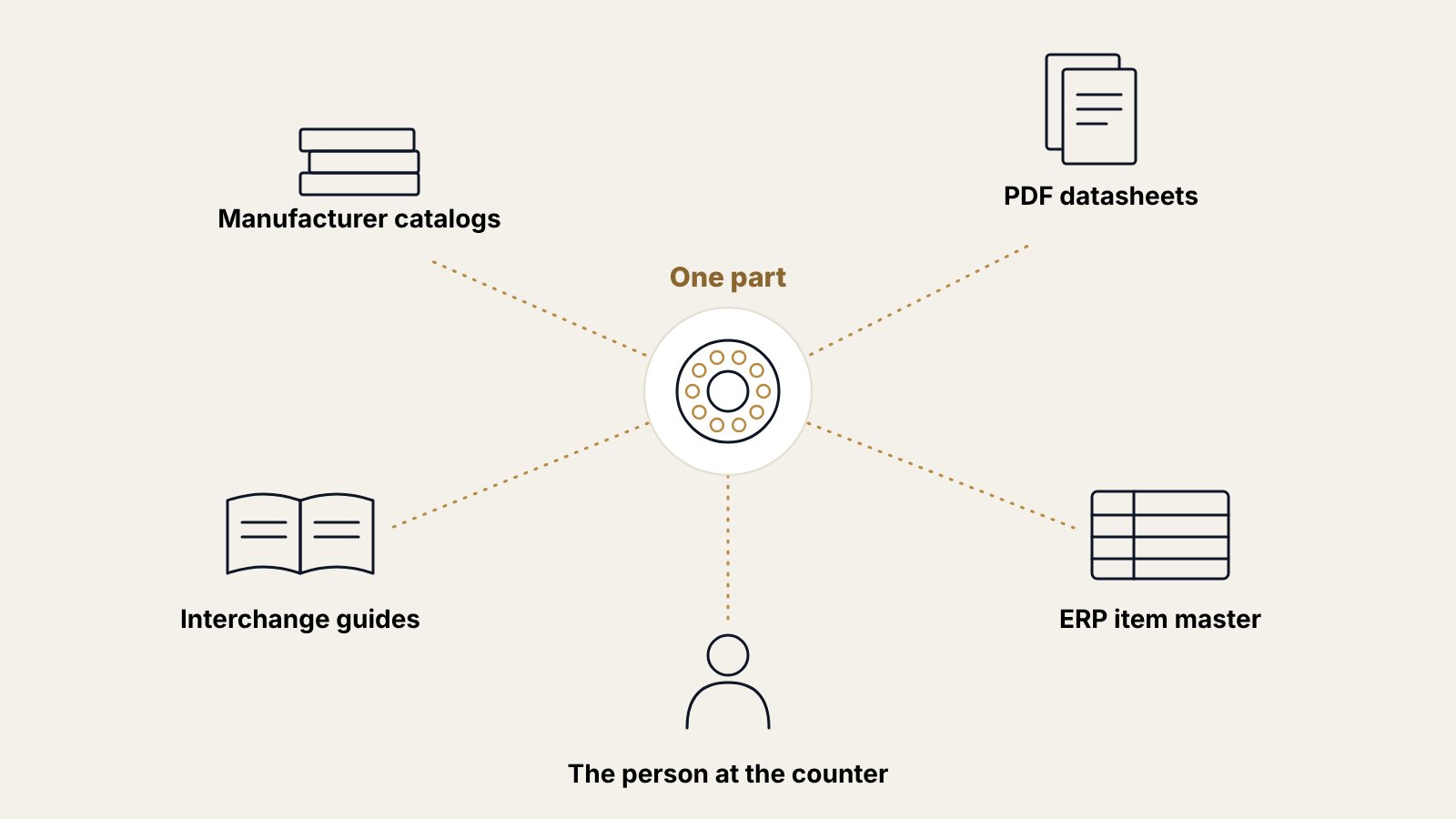
A single gearbox, proximity sensor or pillow block is described in many places at once. Each source is useful. None of them was built to answer the distributor’s real question on its own.
| Source | What it holds | What it can’t tell you |
|---|---|---|
| Manufacturer website and PDF catalog | Specifications, dimensions and the key to that brand’s own numbering | What any other brand calls the same part |
| Manufacturer interchange guide | Competitor numbers mapped to that manufacturer’s own parts | Equivalents that don’t lead back to that brand |
| Distributor ERP item master | What you stock, what it cost, your internal number | Full attributes; the description was cut to fit the field |
| Distributor and e-commerce listings | A description, an image, a price | Whether two listings are the same part |
| The plant’s BOM and maintenance records | What was installed, often under the machine builder’s number | What the part is in manufacturer terms |
| The experienced person at the counter | All of the above, connected | Nothing is written down; very hard to pass along |
Read the last column top to bottom and the pattern is plain. Every source covers its own slice. The connections between slices are held by people.
One part, multiple numbers
Inside a distribution business, the same physical part usually carries at least three identifiers.
The manufacturer part number (MPN) is the orderable number the manufacturer assigns. It is often a base designation plus prefixes and suffixes, and they carry the details that decide fit: frame size, clearance, precision class, coil voltage, contact arrangement… hundreds-of-thousands of attributes.
The distributor SKU or internal number is the distributor’s own number for the item, built to suit its catalog and pricing.
The ERP item number is how the business system tracks the stocked item. In many companies it is the SKU; in others it is a separate internal key, sometimes several of them after acquisitions and system migrations.
Then add OEM numbers, private-label numbers, superseded numbers, national stock numbers, barcode numbers (GTINs) and the plant’s own storeroom numbers; it gets messy fast.
Each number is correct inside the system that created it. The trouble is that none of them points to the others by default, and none of them points across brands at all.
So a distributor can hold an exact equivalent on the shelf and still not find it, because the number on the request and the number in the item master were written by different companies, for different purposes, in different formats.
Why defense, automotive and electrical standardized, and industrial didn’t
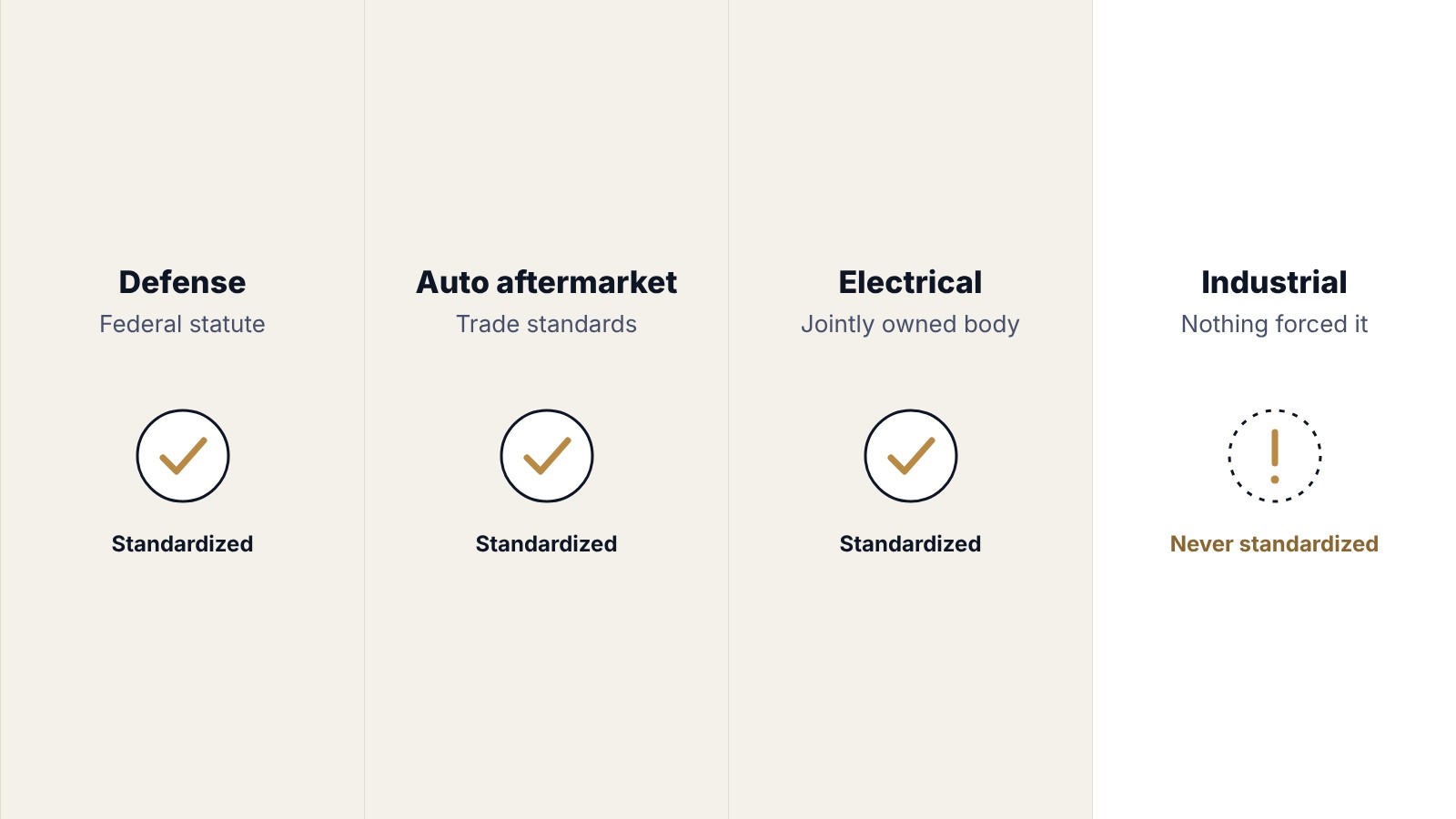
Part identification isn’t an unsolvable problem. Other industries solved versions of it. In each case, something forced the issue.
Defense had a statute. A 1952 act of Congress, carried into federal law as 10 U.S.C. § 2451, directs the Department of Defense to run a unified catalog system. Each item it buys, stocks or distributes is named, described, classified and numbered so that “only one distinctive combination of letters or numerals, or both, identifies the same item” across the department. A buyer that large, with the force of law behind it, can require one identity per part.
The automotive aftermarket had a trade association standard. The Auto Care Association maintains ACES, the industry standard for product fitment data, and PIES, the standard for product information. Both are machine-readable formats shared across trading partners, governed by a committee of volunteers from member companies. The association reports that most companies in the North American automotive aftermarket use them.
Electrical had a jointly owned data body. The National Electrical Manufacturers Association and the National Association of Electrical Distributors established IDEA in 1998. Its mission includes serving as the electrical industry’s standards body and syndicating standardized product data from manufacturers to distributors.
| Industry | What forced it | What it produced |
|---|---|---|
| Defense | Federal statute | A single catalog; one identifier per item across the department |
| Automotive aftermarket | Trade association standards | Shared formats for fitment and product data |
| Electrical | A body owned jointly by manufacturers and distributors | Standardized product data syndicated across the channel |
| Industrial | Nothing comparable | Each manufacturer’s own numbering, connected by people |
Industrial has classification codes and no shortage of catalogs for parts in production. What it never had was the mandate: no single buyer large enough to require one number per part, no shared anchor like a vehicle to hang fitment on, and no channel-wide body with the reach to make every manufacturer’s data line up.
And industrial’s part count is vast, spread across the catalogs of more manufacturers than any one person could ever learn.
Why the fragmentation lasts
Without a mandate, the market settled into an arrangement that works well enough for each participant and poorly for the whole. Several things hold it in place.
Numbering is proprietary by design
Each manufacturer’s part number encodes its own engineering choices in its own order. Two brands can make functionally identical PLCs and write the designations in ways that share almost nothing past the base number.
Interchange data points home
A manufacturer’s cross-reference guide exists to convert a competitor’s number into its own. That is reasonable for the manufacturer. It means the industry’s interchange data is a set of one-way maps, each leading back to a different brand.
Catalogs are treated as assets
Product data takes work to build and maintain, so companies hold it closely. Sharing it widely has rarely had an obvious payoff for any one of them.
The market is wide
The Power Transmission Distributors Association puts the North American power transmission and motion control market at $104 billion, spread across product families from bearings and belt drives to motors, gearing and couplings. Many manufacturers, each with deep product lines, multiply the number of numbering systems a distributor has to read.
Time adds layers
Part numbers get superseded, product lines change hands and brands are retired. A part installed decades ago may carry a number no current catalog lists, even in a mature market where the part itself hasn’t changed.
None of these is anyone’s mistake. Some argue it’s built by design. Each is a rational choice inside one company. Together they produce an industry where the map between parts exists mostly in memory.
What the product data problem costs distributors
The cost doesn’t exactly show up as a line item on a P&L. Imagine if it did: “Bob, 2.5 hours identifying 8 parts for order# 0871225: $209.70.” It is spread across ordinary days at the counter, on the phone and in the inbox. Product Discovery requires a tremendous amount of back-and-forth communication, and it usually takes the 40-year veteran.
Time to identify
Before anyone can quote, pull or order, someone has to work out what the customer actually needs; what is the orderable MPN? When the request arrives as a competitor’s number, a description or a partial designation, that work falls to whoever knows enough to do it.
Wrong parts and returns
A missed suffix is a different part. The wrong preload, revision or coil voltage turns into a return, a second shipment and a customer who remembers it. Nomenclature is vast regarding industrial parts.
Orders lost to the first answer
A plant with a line down often calls more than one supplier. The distributor that identifies the part and confirms it is in stock first tends to win the order, and the one still researching doesn’t. Price doesn’t mean much when a line is down.
Stock that can’t be found
An exact equivalent can sit in your own warehouse under another brand’s number. If nothing links it to the number on the request, it doesn’t get sold, and capital stays frozen in it.
Missed add-ons
The parts that go with the order, such as seals and adapters for a bearing or the overload relay that pairs with a motor starter, depend on someone knowing how the system is built. When that knowledge isn’t at hand, the order goes out smaller than it could have been, and the customer may not have everything needed to put that machine back together.
A worked example: the contactor on the inside sales desk
A maintenance planner emails an inside sales desk with a catalog number for a three-pole IEC contactor from a brand the branch doesn’t carry. The line it controls is down.
The rep’s first job is to decode the number. The manufacturer’s selection matrix, in a PDF, shows which characters set the current rating, which set the coil voltage and frequency, and which set the auxiliary contacts. That takes a few minutes if the rep knows where to look.
The second job is finding the equivalent in a brand the branch stocks. That brand writes its numbers in a different order with different codes. The rep has to match the rating, the coil, the auxiliary arrangement and the mounting, attribute by attribute.
The third job is checking the shelf. The item master describes the stocked contactors in abbreviated text, trimmed to fit a field, and not every record states the coil voltage. The rep pulls up several candidates and checks them against the brand’s catalog one at a time.
The right part was on the shelf the whole time. Whether the planner gets it today depends on how long those three steps take, and whether a competitor finishes them first. Get the coil voltage wrong and the contactor won’t do its job when it’s installed.
Nothing in that sequence is unusual in industrials. It happens many times a day, in every branch, across every product family.
The people holding it together are retiring
For decades, the industry has closed the knowledge shortfall with experienced people. They know the nomenclature, the supersessions, the look-alikes and what goes with what. That system works, as long as those people are there.
The PT/MC channel’s own association has named the risk: 15% of distributors and 12% of manufacturers said they have defined and consistent knowledge-transfer practices. Distributors (55%) and manufacturers (44%) named tacit knowledge, the judgment built through years of experience, as the hardest kind to pass on. The article put the deficit in one line: “Training can teach the fundamentals. Experience teaches the exceptions.”
The age profile points the same way. In 2025, about 87,000 of the 338,000 people employed by U.S. machinery, equipment and supplies merchant wholesalers were 55 or older, according to the Bureau of Labor Statistics.
The customer side faces it too. The Manufacturing Institute and Deloitte project that U.S. manufacturing could need as many as 3.8 million additional employees between 2024 and 2033, with as many as 1.9 million of those jobs at risk of going unfilled. The newer maintenance planners calling the counter will lean on their distributors for more of what they don’t yet know.
Industry voices are drawing the same conclusion. The silver tsunami is turning into a category 5 hurricane.
Distribution Strategy Group argues that the retirement wave is a knowledge problem as much as a hiring one, and that the time to capture what veterans know is while they are still on the payroll. “You can’t recruit your way out of a demographic cliff.”
National Association of Wholesaler-Distributors describes the inside sales job in the same terms we see it: customers seldom call with a clean part number, and the rep turns a description into a product family, the specifications that matter and the right item or substitute. Their view is simple: when every distributor faces the same problem, no one should have to solve it alone. Until that happens, each house keeps rebuilding its own answer to product discovery, over and over.
What solving it actually takes
Search engines and AI assistants are now where many part searches start, and they still miss on industrial parts. Even with google and chatGPT “helping,” the person behind the wheel still needs to be an expert. In one industrial-specific study, the top-scoring general-purpose model, with web search on, got 46 of 100 industrial parts questions fully right. That’s not an AI problem. It’s a data problem.
Search engines and AI systems need a repository of structured, normalized product data.
Better search alone doesn’t close this void, because the connections aren’t in the documents for search to find. The knowledge has to be built as structured data. In practice, that means a few things.
Product Discovery: Identity. Each orderable part needs one record, with its full number decoded into what each character means. A base designation and a full designation have to be understood as different things.
Attributes by product type. A pneumatic cylinder needs to be described the same way whichever brand made it: bore, stroke, mounting, port size. That is what makes two brands comparable at all.
Cross-Referencing: equivalence, with conditions. Interchange data has to run in every direction, and it has to say what kind of match it is. A direct interchange and a functional equivalent are different answers, and the person quoting needs to know which one they have.
Cross-selling: what goes with it. The parts that belong on the same order come from how systems are built, and they can be recorded too.
Your own shelf. The answer is only useful to a distributor if it lands on the item master: the equivalent you already own, under the number your system uses.
Upkeep. Supersessions, discontinued lines and new releases keep moving. The record has to move with them. Parts and products do change, which is why zero-latency accuracy matters. A record that was right last quarter can be wrong today, and in this business a stale answer is a wrong answer. The standard has to be 100% verified, every time.
None of this needs a mandate from Congress or an industry-wide vote. It needs the knowledge experienced people carry to be written down as data while those people are still here to check it, the subject matter experts (SMEs) and product engineers. The mandate industrial never had may turn out to be the retirement of the people who held it together.
Key terms
- Manufacturer part number (MPN): The orderable number a manufacturer assigns to a specific version of a part, including the nomenclature that defines it.
- Distributor stock keeping unit (SKU): A distributor’s own identifier for an item it sells.
- Item master: The list of items in a distributor’s ERP system, with the descriptions and numbers the business uses internally.
- Direct interchange: (MPN to MPN) A part from another manufacturer that matches the original in form, fit and function without qualification. Other terms – Alternate, Cross-Reference, Substitute, Equivalent, Replacement Reference, Also-known-as.
- Functional equivalent: A part that does the same job in the application but differs in some attribute, so the conditions of the match need to be known.
Sources
- 10 U.S. Code § 2451, Defense supply management. Legal Information Institute, Cornell Law School.
- Data Standards (ACES and PIES). Auto Care Association.
- About IDEA. Industry Data Exchange Association.
- About the PT/MC Industry. Power Transmission Distributors Association.
- Who Will Know What the Industry Used To Know? Transmissions, 2026 Volume 3. PTDA.
- Employed persons by detailed industry and age, Table 18b, 2025 annual averages. U.S. Bureau of Labor Statistics.
- Manufacturers Need as Many as 3.8 Million New Employees by 2033. The Manufacturing Institute.
- Your Best People Are Retiring, But Your Best New Hire Is AI. Distribution Strategy Group.
- As AI Learns Distribution, Distributors Must Teach it Well. Modern Distribution Management.
- Study: AI Models Top Out at 52% on Industrial Parts Questions. MDM, reporting on Reshape Automation’s Industrial AI Accuracy Index 2026.
Leave a Reply